
Prosthetics in Płock – aesthetic and functional tooth restoration
Tooth loss affects not only the appearance of your smile, but also chewing, speech, and the functioning of the temporomandibular joint. At Panorama Uśmiechu, we perform modern prosthetic restorations – fixed, removable and implant-based – restoring full function, aesthetics and comfort to patients of all ages. We plan prosthetic treatment based on 3D scanning, radiological diagnostics and occlusion analysis, which allows us to achieve a durable, perfectly fitted result.
What does dental prosthetics involve?
Prosthetics restores lost teeth and reconstructs those that have been damaged or broken. It includes both permanent and removable restorations, tailored to the individual needs of the patient.
We perform prosthetic restorations when the patient:
- has lost one or more teeth,
- is edentulous and needs a stable denture,
- wants to improve the aesthetics and proportions of their smile,
- requires occlusal reconstruction (e.g., due to tooth wear),
- needs restoration after root canal treatment, injury, or extraction.
Prosthetics is not only about aesthetics — it is about restoring the full function of the masticatory organ and protecting the temporomandibular joint.
What types of prosthetic restoration do we perform?
The choice of prosthetic solution depends on the number of missing teeth, the condition of the teeth and bone, and the patient’s aesthetic expectations.
Permanent restorations — durable and highly aesthetic
Veneers – they improve the shape, colour and proportions of the front teeth. Ideal for discolouration, cracks, and uneven edges.
All-ceramic and zirconium crowns – used for extensive damage or after root canal treatment. Durable, natural, and resistant to discolouration.
Prosthetic bridges – allow you to replace one or more missing teeth without using a removable denture.
Inlays, onlays, overlays, endocrowns – when a tooth is damaged, but part of it can be preserved. More durable than classic fillings.
Removable restorations — when there are extensive gaps in the dentition
Skeletal dentures – stable, comfortable and based on a metal framework — they do not burden the mucous membrane like acrylic dentures.
Telescopic dentures – very aesthetic and easy to maintain. They provide excellent stability.
Immediate dentures – fitted immediately after extraction — the patient does not have to walk around without a tooth.
Prosthetic work on implants
Crowns on implants,
Bridges on implants,
Full dentures stabilised with implants (comfort similar to natural teeth), i.e., “AllOn4” type work.
These are the most durable and natural-looking solutions.
How does prosthetic treatment work at Panorama Uśmiechu?
The process is individual, but usually includes:

Consultation and dental diagnosis
We perform:
- 3D scan of teeth,
- photographs,
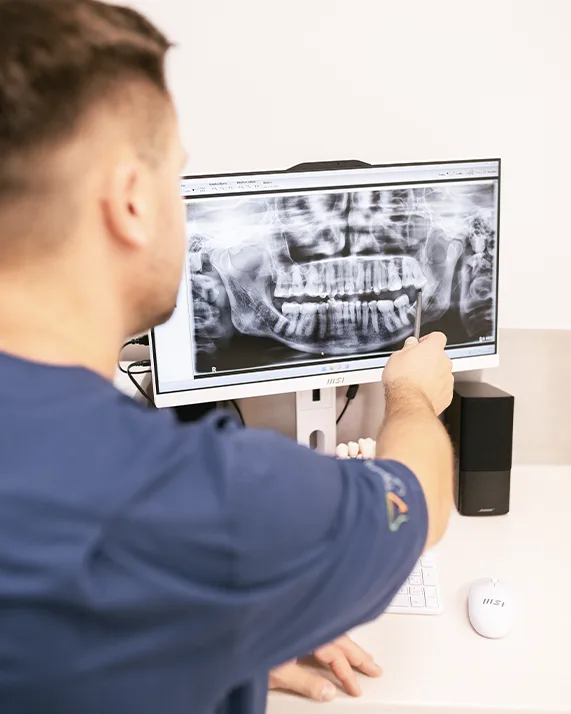
- panoramic X-ray or CBCT,
- occlusion analysis and temporomandibular joint assessment.
This allows us to determine the best method of restoration.

Treatment plan and selection of restoration
The dentist presents:
- possible prosthetic solutions,
- differences between materials (composite, porcelain, zirconium),
- aesthetic options and the expected effect,
- schedule and cost estimate.

Preparation for restoration
If necessary:
- we treat teeth conservatively,
- we perform root canal treatment,
- we refer you to a periodontist, orthodontist, or surgeon.
The priority is a stable and healthy foundation for tooth restoration.

Prosthetic work
Depending on the type of restoration:
- we take a 3D dental scan,
- we prepare the tooth (minimally, if necessary),
- we perform the work digitally, using CAD/CAM technology,
- we adjust the colour, shape, and bite height,
- we deliver the work and check its function.

Check-up, adjustments and final fitting
After reconstruction, we perform:
- bite check-up,
- joint function assessment,
- recommendations regarding oral hygiene and use,
- schedule of follow-up visits.
Thanks to digital precision, the effect is durable and predictable.
Why should you choose us for your prosthetic work?

3D dental diagnostics and full bite analysis before treatment

Highest quality materials: E-max porcelain, zirconium, premium composites

Digital smile design and CAD/CAM technology

Intraoral scanner – no uncomfortable impressions

Aesthetic and natural results, individually tailored

Comprehensive restoration of the entire occlusion

Cooperation between prosthodontists, orthodontists, periodontists and implantologists

Holistic approach – aesthetics + function + temporomandibular joint health
FAQ
A crown restores a single tooth. A bridge consists of several connected crowns and replaces one or more missing teeth, resting on adjacent teeth or implants.
It is a quick and comfortable procedure. A scanner moved along the teeth creates a digital 3D model – without impression materials. The file is sent to a technical laboratory, reducing the time needed to complete the work.
Usually, 7–14 days. We can make a temporary crown, so that the patient does not have to walk around with a gap in their teeth.
No. We prepare the tooth and perform the subsequent stages of treatment under local anaesthesia, which ensures comfortable and controlled conditions for therapy.
A veneer improves the aesthetics of a tooth if its structure is preserved. A crown is necessary when the tooth is severely damaged, or after root canal treatment.
10–15 years, often longer — with good hygiene, regular check-ups, and no overloading.
Yes. We fit it immediately after tooth extraction, so that the patient does not have to go without a replacement. It then needs to be adjusted or replaced.
Yes. An implant-supported denture is much more stable, comfortable, and functional than a conventional one.
Want to regain comfortable chewing and an aesthetic smile?
Make an appointment for a prosthetic consultation at Panorama Uśmiechu – we will find the perfect solution for you.